CPIM or CSCP: How to Choose the Right APICS Certification for Your Role
CPIM or CSCP: How to Choose the Right APICS Certification for Your Role
Choosing between CPIM and CSCP is one of the most common questions for supply chain professionals looking to strengthen their expertise and advance their careers. Developed by the ASCM (formerly APICS), CPIM and CSCP are widely regarded as the world’s leading supply chain certifications, recognized across industries and international markets for setting the standard in supply chain education.
Yet many professionals struggle with the same question: Which certification fits my role better?
The answer depends less on which one is “better” and more on your responsibilities, career goals, and the scope of your work. This guide helps clarify the differences so you can make an informed decision.
CPIM vs CSCP at a Glance
Before diving deeper, it helps to understand the core distinction.
CPIM (Certified in Planning and Inventory Management) focuses on internal operations, planning processes, and inventory optimization.
CSCP (Certified Supply Chain Professional) takes a broader view, covering end-to-end supply chain strategy across suppliers, manufacturers, logistics, and customers.
In simple terms:
- CPIM = depth in internal operations
- CSCP = breadth across the full supply chain
This distinction is often the most important starting point.
Who Should Choose CPIM?
CPIM is often the best fit for professionals directly involved in operational planning and execution.
Typical roles include:
- Production planners
- Inventory managers
- Demand planners
- Materials managers
- Operations supervisors
- Plant Managers
If your daily work involves balancing inventory, scheduling production, forecasting demand, or improving internal workflows, CPIM aligns closely with those responsibilities.
Why CPIM Makes Sense
CPIM provides structured knowledge in:
- Master planning
- Material requirements planning (MRP)
- Capacity planning
- Inventory control
- Production execution
For professionals aiming to improve operational efficiency or specialize in planning disciplines, CPIM offers highly practical knowledge.
Example Scenario
A Planning Manager working in manufacturing often benefits more from CPIM because it directly addresses the operational challenges they face every day.
Who Should Choose CSCP?
CSCP is typically more relevant for professionals with broader supply chain responsibilities.
Typical roles include:
- Supply chain managers
- Procurement leaders
- Logistics managers
- Consultants
- Distribution managers
If your work spans multiple departments, suppliers, or regions, CSCP may be the stronger choice.
Why CSCP Makes Sense
CSCP focuses on:
- Global supply chain design
- Supplier relationship management
- Risk mitigation
- Logistics and distribution
- Customer integration
- Supply chain transformation
It is particularly valuable for professionals moving into leadership or strategic roles.
A typical example would be a Supply Chain Manager responsible for supplier coordination, logistics, and customer delivery, where CSCP is often more closely aligned with the scope of the role.
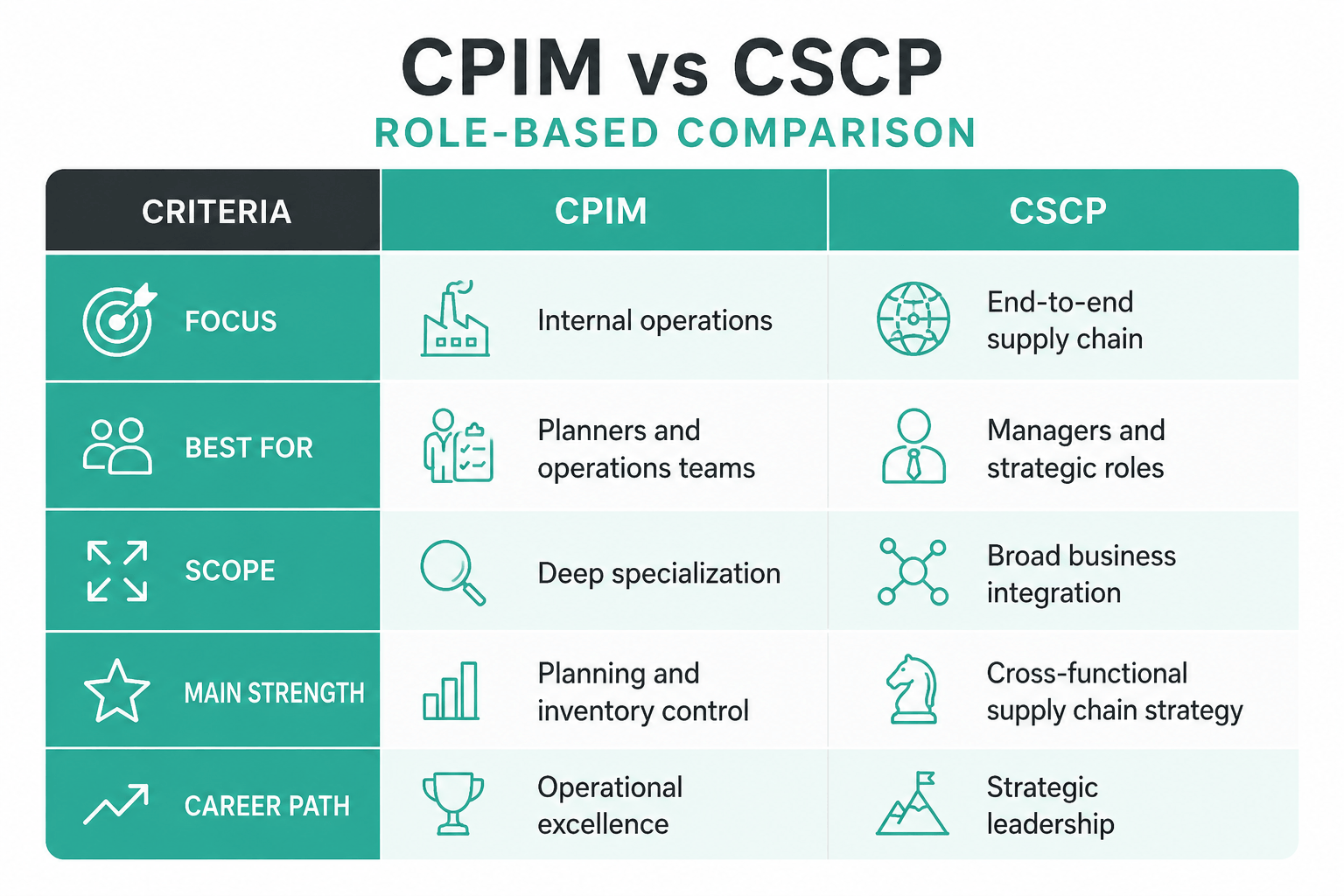
This comparison helps reduce the confusion many professionals face when comparing the two.
Which Certification Should You Take First?
This is one of the most frequent concerns.
A useful rule of thumb:
- Choose CPIM first if your current role is operational and detail-oriented.
- Choose CSCP first if you already work across multiple supply chain functions.
For some professionals, both certifications can complement each other over time.
A common progression looks like this: CPIM → CSCP
This path allows professionals to build strong operational foundations before expanding into strategic supply chain management.
However, this is not a fixed rule. Your starting point should reflect your current responsibilities.
Questions to Ask Before Deciding
If you are still uncertain, ask yourself:
1. Is my role mostly internal or cross-functional?
Internal usually points to CPIM. Cross-functional often points to CSCP.
2. Do I want specialization or broader visibility?
CPIM builds depth. CSCP builds range.
3. Where do I want my career to go?
Future career direction matters as much as your current job.
4. Am I solving operational problems or strategic ones?
Your daily challenges often reveal the best fit.
Final Thoughts
There is no universal answer to the CPIM vs CSCP decision.
The best certification is the one that aligns with:
- Your current responsibilities
- Your professional goals
- The type of problems you solve
- The scope of your influence
If your work is deeply connected to planning, production, and inventory, CPIM often provides the strongest value.
If your focus is broader and includes suppliers, logistics, and end-to-end optimization, CSCP may be the better choice.
The goal is not simply to earn a certification, but to choose one that strengthens your ability to make better supply chain decisions.
For further information about the CPIM and CSCP courses, and to receive support in deciding which course to choose, contact us via email: info@advanceschool.ch or by phone at +41 79 5974100.
About Advance School: AdvanceSchool is the only Premier ELITE Partner of APICS in Switzerland, and has trained worldwide thousands of professionals from all organizational levels in the Operations and Supply Management areas.
News from Advance
Return to the List


Bologna, Italy
Via Massimo D’Azeglio, 35 – 40123
Tel: +39 051 19907026
Mobile: +39 3775773275
Mail: info@advanceschool.org
© 2026 Advance Operations Management School GmbH – UID: CHE-221.069.731 - share capital 20'000.00 CHF