SCOR model: how to use it to understand supply chain performance
The SCOR model is practical when it is used as a diagnostic framework rather than as a catalogue of supply chain processes. Its purpose is to give managers a common language for describing how work is performed, connecting processes with performance measures and identifying where an operational problem may originate.
This is particularly useful when a company can see the symptom but not the underlying cause. Poor delivery performance, excess inventory, unstable lead times or rising operating costs may appear in one function while originating elsewhere in the supply chain. SCOR helps teams replace isolated interpretations with a structured process map.
The current SCOR Digital Standard, or SCOR DS, is organized around seven primary management processes: Orchestrate, Plan, Order, Source, Transform, Fulfill and Return. Together, they provide a consistent structure for assessing and improving supply chain performance.
What the SCOR model is and why companies use it
SCOR stands for Supply Chain Operations Reference. It is a reference framework designed to describe the business activities associated with satisfying customer demand.
Its value does not come from reproducing every activity performed by an individual company. The model provides standardized definitions that allow different functions, business units and organizations to examine supply chain processes through the same structure.
A planning manager, procurement manager and logistics manager may use different terminology to describe the same operational issue. One function may interpret a late delivery as a supplier problem, another as a planning failure and another as a transport constraint. SCOR gives these teams a shared map on which to locate the issue and test the relationships between processes.
The framework is therefore useful for three related purposes:
- describing supply chain processes consistently;
- measuring performance through common definitions;
- identifying gaps that may require operational or organizational improvement.
SCOR does not automatically provide the answer to a performance problem. It structures the investigation so that the company can ask better questions, compare evidence and avoid analysing each function in isolation.
Why SCOR is a diagnostic framework rather than a theoretical process list
The names of the SCOR processes are easy to learn. Applying them requires a different level of understanding.
A theoretical reading treats Plan, Source or Fulfill as categories. A diagnostic reading asks how each process contributes to a measurable business outcome and whether problems in one area are being caused by another.
Suppose a company experiences repeated delays in customer deliveries. The visible problem appears in Fulfill because orders are not reaching customers at the expected time. The cause, however, may be located in several places:
- Order may be accepting commitments that are not operationally feasible;
- Plan may not be balancing demand and available capacity effectively;
- Source may be experiencing unstable supplier lead times;
- Transform may be producing below the planned rate;
- Fulfill may have warehouse or transport constraints;
- Orchestrate may not provide clear governance, data ownership or escalation rules.
The framework helps the company move from the statement “delivery performance is poor” to a more precise set of diagnostic hypotheses.
This reduces the tendency to select solutions too early. Adding safety stock, changing a supplier or increasing transport capacity may appear reasonable, but each intervention addresses a different cause. SCOR provides a structure for determining which cause is supported by the available evidence.
How the SCOR Digital Standard structures the supply chain
The SCOR Digital Standard organizes supply chain activity around seven primary processes. Orchestrate provides the integrating layer, while Plan, Order, Source, Transform, Fulfill and Return describe the principal operational flows.
The sequence should not be interpreted as a rigid linear chain. Modern supply chains contain parallel activities, feedback loops, external partners and decisions that occur at different planning horizons.
The model is better understood as a set of connected process blocks. Each block allows managers to isolate an area for analysis without losing sight of its dependencies.
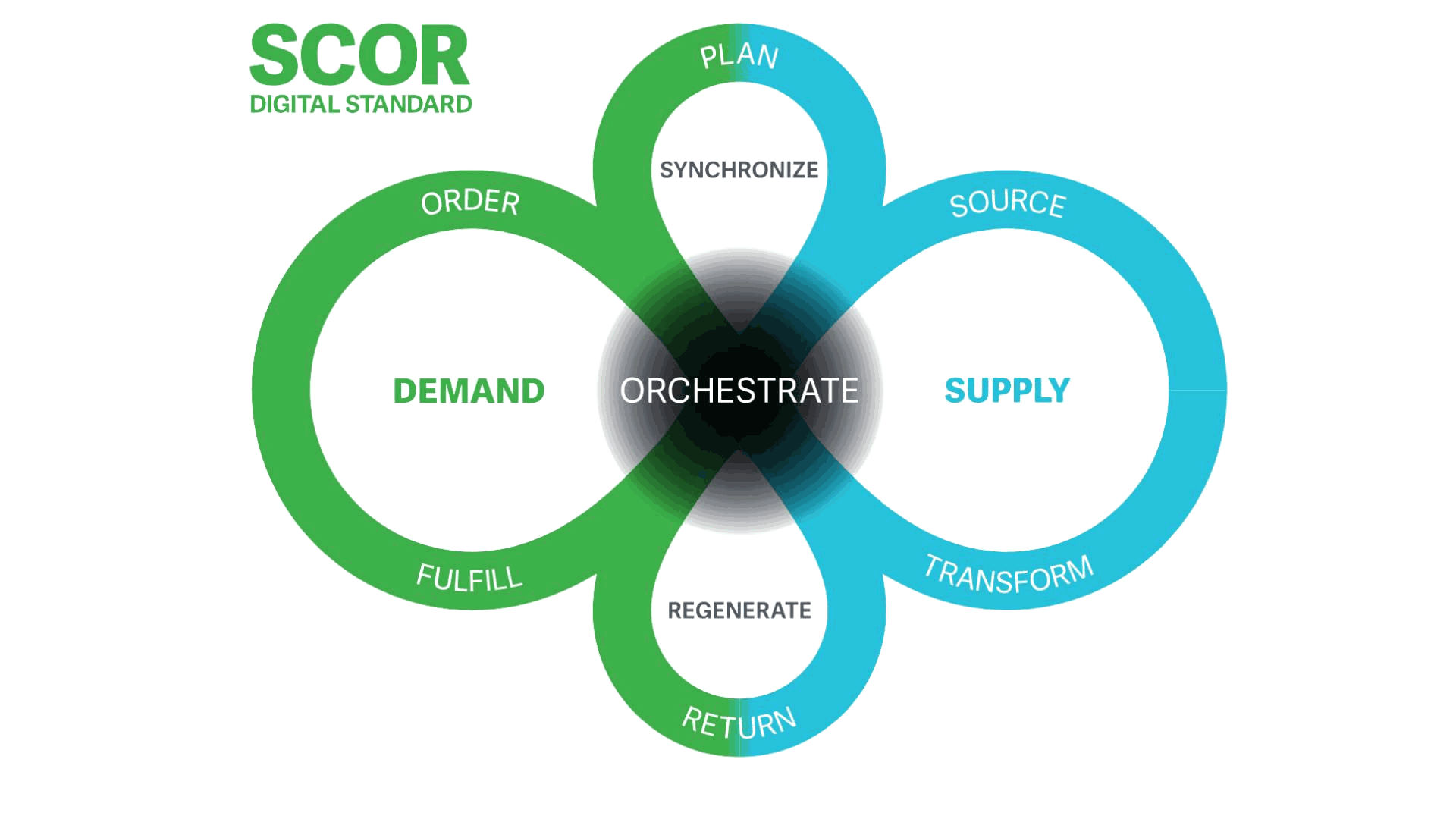
Orchestrate as the integrating layer of the model
Orchestrate connects the operational processes with the management capabilities required to make them function as a system.
These capabilities include areas such as strategy, governance, performance management, risk, data, technology, people and organizational design. Orchestrate therefore addresses the conditions under which Plan, Order, Source, Transform, Fulfill and Return are managed.
A company may have well-designed operational processes but still perform inconsistently because responsibilities are unclear, data definitions differ or decisions are escalated too slowly. These are not necessarily failures inside an individual operational process. They are orchestration problems.
Plan, Order, Source, Transform, Fulfill and Return as operational processes
The six operational areas provide a map of the activities involved in balancing resources, receiving demand, obtaining inputs, converting them, fulfilling commitments and managing reverse flows.
They can be analysed separately, but their diagnostic value increases when their relationships are made explicit.
Plan influences the targets and constraints used by Source, Transform and Fulfill. Order translates customer demand into commitments. Source provides the materials and services required for execution. Transform converts inputs into products or services. Fulfill completes the customer commitment. Return manages reverse flows that may reveal weaknesses elsewhere in the system.
Orchestrate: connecting strategy, governance and performance
Orchestrate prevents supply chain analysis from becoming a collection of local process reviews.
It asks whether the organization has the management mechanisms required to align supply chain activity with business objectives. This includes the allocation of responsibilities, the governance of information and the way performance is reviewed across functions.
Business rules, risk and decision governance
Supply chain performance depends partly on the rules used to make decisions.
A planning system may generate a feasible production proposal, but management rules determine whether customer priorities, working-capital constraints and supply risks are reflected in the final decision. Procurement may identify a vulnerable supplier, but governance determines who can approve qualification of an alternative source.
SCOR analysis should therefore consider:
- who owns the relevant process;
- which decisions can be made at each organizational level;
- which thresholds trigger escalation;
- how risk is included in operational decisions;
- whether business rules are consistent across functions.
When governance is unclear, operational problems tend to remain unresolved even when their technical causes are understood.
People, technology and data as process enablers
Processes cannot be assessed independently from the capabilities that support them.
A forecasting process may be logically sound but weakened by inconsistent master data. A sourcing process may be delayed by fragmented approval systems. A fulfillment team may lack accurate inventory visibility despite following the defined procedure.
The diagnostic question is not simply whether the company has technology or data. It is whether these enablers allow the process to deliver its intended result.
People are equally important. Roles require the knowledge and judgement to interpret information, resolve exceptions and coordinate decisions. A process description can specify what should happen, but competence determines whether the organization can perform it under real operating conditions.
Performance management across the supply chain
Local metrics can improve one function while damaging the performance of the overall supply chain.
Procurement may reduce purchase prices by selecting longer lead times. Manufacturing may improve utilization by producing larger batches. Logistics may reduce transport cost by consolidating shipments. Each decision can appear successful within the function while increasing inventory, reducing responsiveness or weakening customer service.
Orchestrate provides the perspective needed to examine these trade-offs.
The SCOR framework connects process analysis with performance attributes, allowing managers to compare results across dimensions rather than optimizing a single measure. This supports a more balanced view of performance and makes conflicts between functional objectives visible.
Plan: synchronizing demand, supply and resources
Plan describes the activities used to develop the road maps through which the supply chain operates. In SCOR DS, planning is performed for Order, Source, Transform, Fulfill and Return, including the comparison of requirements with available resources and the identification of actions to close gaps.
The Plan process is therefore broader than demand forecasting. It includes the balancing and coordination required to translate business expectations into executable decisions.
What the Plan process helps managers examine
A diagnostic review of Plan may consider:
- how demand assumptions are developed and updated;
- whether capacity, inventory and supplier constraints are visible;
- how planning horizons are connected;
- whether commercial and operational priorities are aligned;
- how quickly the plan responds to significant variation;
- whether decisions are translated into clear requirements for execution.
The purpose is not to evaluate forecast accuracy alone. A company may have a reasonable forecast and still perform poorly because planning decisions are late, constraints are not represented or functions use different assumptions.
Typical performance gaps revealed through planning analysis
Planning weaknesses often appear as operational symptoms elsewhere.
Frequent schedule changes may indicate unstable demand signals or inadequate planning discipline. High inventory may reflect poor segmentation or an attempt to compensate for unreliable execution. Low service levels may result from plans that do not account for real supplier or production constraints.
SCOR helps connect these symptoms to the planning activities that influence them. It also prevents the company from treating every performance gap as a forecasting problem.
Order: understanding how demand enters the supply chain
Order covers the processes through which customer demand is captured, validated, confirmed and managed.
This area is diagnostically important because the supply chain cannot execute reliably when commitments are based on incomplete information or unrealistic assumptions.
Order capture, validation and customer commitments
Order analysis examines how a customer request becomes an operational commitment.
Relevant questions include:
- Is the order complete and accurate when it enters the system?
- Are product, quantity and delivery requirements validated?
- Is availability checked against current supply and capacity?
- Are exceptions identified before confirmation?
- Are changes communicated consistently across functions?
A high volume of manual corrections, order changes or disputed delivery dates may indicate that the problem begins before sourcing, production or fulfillment.
How order management problems affect downstream performance
Poor order quality creates instability throughout the supply chain.
Incorrect specifications can cause purchasing or production errors. Unrealistic promises can create urgent schedule changes. Late order modifications can increase inventory, transport cost and operational complexity.
SCOR separates Order from Fulfill so that the company can distinguish between the quality of the customer commitment and the quality of its execution.
This distinction is useful because a late delivery is not always a logistics failure. It may be the predictable result of a commitment that was never feasible.
Source: diagnosing supplier and inbound performance
Source includes the activities required to obtain products and services from suppliers.
The process covers more than supplier selection or negotiation. It also includes the execution and coordination required to make inputs available when they are needed.
Supplier reliability, availability and lead-time performance
Source analysis may examine:
- supplier delivery reliability;
- actual versus agreed lead times;
- material availability;
- order confirmation and change management;
- incoming quality;
- inbound coordination;
- dependency on specific suppliers or locations.
The diagnostic objective is to determine whether supply-side performance is causing instability elsewhere in the network.
A supplier can meet its contractual delivery date and still create operational problems when the agreed lead time is incompatible with planning requirements. Conversely, procurement performance may appear weak when the underlying cause is poor demand visibility or repeated schedule changes.
Distinguishing sourcing problems from planning problems
Source and Plan are closely connected.
When purchase requirements change repeatedly, suppliers may struggle to respond. When suppliers provide unreliable confirmations, the plan becomes unstable. The resulting shortage can be attributed to either function unless the relationship is examined systematically.
SCOR encourages managers to test both sides of the interaction.
The key question is whether the performance gap originates in supplier execution, internal planning decisions or the interface between them.
Transform: analysing how inputs become products or services
Transform covers the processes through which inputs are converted into products or services.
The term extends the scope beyond the traditional concept of manufacturing. It allows the framework to represent different forms of conversion, including service environments and operational models in which value is created without a conventional production line. ASCM introduced Transform as part of the updated digital standard, replacing the narrower legacy category Make.
Capacity, cycle time, quality and execution
Transform analysis can examine:
- available and effective capacity;
- process cycle times;
- schedule adherence;
- yield and quality performance;
- changeover or setup constraints;
- work-in-progress;
- labour and equipment availability;
- rework and process variation.
The framework helps connect these measures to customer and financial outcomes.
For example, low schedule adherence may reduce fulfillment reliability. Long cycle times may increase working capital and weaken responsiveness. Quality failures may create returns, additional transport and customer dissatisfaction.
Why Transform extends beyond traditional manufacturing
Many supply chains create value through configuration, assembly, treatment, packaging, information processing or service delivery.
Using Transform rather than Make provides a broader diagnostic lens. The central question is how inputs are converted into the output required by the next process or customer.
This makes SCOR applicable across a wider range of operating models without changing its basic logic.
Fulfill: measuring the execution of customer commitments
Fulfill covers the activities required to complete the customer commitment.
It includes the handling, preparation and movement of products or services toward the customer. Warehousing, inventory allocation, transportation and delivery execution may all contribute to fulfillment performance.
Inventory, warehousing, transport and delivery
A Fulfill diagnosis may consider:
- inventory availability and allocation;
- picking and preparation accuracy;
- warehouse capacity and productivity;
- transport planning;
- carrier performance;
- documentation;
- delivery visibility;
- proof of completion.
The process should be evaluated against the customer commitment established through Order and the resources defined through Plan.
Fulfillment cannot be assessed meaningfully when the original commitment is unclear or when upstream constraints have already made execution impossible.
Identifying the causes of poor fulfillment performance
Late or incomplete delivery may be caused by a problem inside Fulfill, but the analysis should not stop there.
Warehouse congestion may result from unstable production output. Emergency transport may be caused by late supplier deliveries. Low inventory availability may reflect planning policies rather than warehouse execution.
SCOR provides a map for tracing the performance gap across process boundaries.
Return: including reverse flows in performance analysis
Return covers the reverse movement of products, materials or other items through the supply chain.
Returns may result from defects, excess supply, delivery errors, customer requirements, repair, reuse or end-of-life processes.
Returns as a source of cost, inventory and customer impact
Returns affect several areas of performance:
- transport and handling cost;
- inventory availability;
- working capital;
- customer experience;
- quality management;
- sustainability objectives;
- recovery or disposal decisions.
Treating Return as a separate process makes these effects visible. Without this distinction, reverse flows may be absorbed into logistics or customer service reporting and receive limited management attention.
Using return data to identify upstream process weaknesses
Return data can reveal problems in Order, Source, Transform or Fulfill.
Incorrect products may indicate order-entry or picking errors. Defects may originate in supplied materials or transformation processes. Damage may point to packaging or transport weaknesses. Excess returns may reflect inaccurate customer commitments or poor demand understanding.
Return is therefore both an operational process and a source of diagnostic evidence.
How SCOR connects processes with performance metrics
A process map explains where work is performed. Metrics indicate how well the process is achieving its intended result.
SCOR uses standardized performance attributes to organize measurement. Official SCOR DS material includes attributes such as reliability, responsiveness, agility, cost and asset management; more recent reference material also expands the overall performance structure beyond these traditional categories.
For practical diagnosis, the first five provide a clear starting point.
Reliability, responsiveness and agility
Reliability concerns the ability to perform as expected. It may include the completeness, accuracy and timing of supply chain outcomes.
Responsiveness concerns the speed at which the supply chain completes its activities and satisfies demand.
Agility concerns the ability to respond to external change. The SCOR DS information model describes agility in terms of responding to external influences and the capability and speed of change.
These attributes should not be treated as interchangeable.
A supply chain can be reliable under stable conditions but lack agility when demand or supply changes. It can be responsive through expensive emergency actions while performing poorly on cost. SCOR makes these distinctions explicit.
Cost and asset management efficiency
Cost measures the resources consumed by supply chain activities.
Asset management considers how effectively assets support supply chain operations. This may include inventory, working capital, facilities or other resources used to deliver performance.
These attributes help managers evaluate the economic consequences of operating choices.
A service improvement achieved through excessive inventory may not represent balanced performance. A cost reduction that creates longer lead times or lower reliability may weaken the supply chain’s competitive position.
Selecting metrics that support diagnosis rather than reporting alone
A metric is diagnostically useful when it helps test a possible cause.
A dashboard may contain dozens of indicators without clarifying why performance is changing. SCOR encourages the selection of measures connected to the process under review and the business outcome being investigated.
The sequence should be:
- define the performance problem;
- identify the relevant attribute;
- locate the processes that influence it;
- select measures that can confirm or reject possible causes.
This is more effective than beginning with the available data and attempting to infer a problem from every variation.
A practical method for using SCOR as a diagnostic map
SCOR can be applied through a disciplined sequence that connects the visible performance issue with processes, measures and improvement priorities.
Start with a measurable performance problem
The initial problem should be specific enough to investigate.
“Fulfillment is inefficient” is too broad. “The percentage of complete customer orders delivered by the confirmed date has declined over the last two quarters” provides a clearer basis for analysis.
The statement should identify:
- the outcome affected;
- the relevant customer or business segment;
- the period in which the change occurred;
- the size or direction of the gap;
- the business consequence.
This prevents the diagnostic process from becoming a general review of the entire supply chain.
Map the problem to the relevant SCOR processes
The visible location of the problem provides the first process hypothesis.
A delivery issue initially points to Fulfill. A material shortage points to Source. Excess work-in-progress points to Transform or Plan.
The first process is not necessarily the root cause. It is the starting point for tracing dependencies.
Identify dependencies between process areas
The next step is to examine which upstream or enabling processes influence the result.
For a fulfillment problem, the company may review:
- whether Order created a feasible commitment;
- whether Plan allocated sufficient inventory and capacity;
- whether Source supplied inputs reliably;
- whether Transform completed output as scheduled;
- whether Orchestrate provided adequate data, ownership and escalation.
This creates a process map of the performance problem.
Use metrics to test possible causes
Each hypothesis should be linked to evidence.
Supplier lead-time variation may test a Source hypothesis. Schedule adherence may test a Transform hypothesis. Order-change frequency may test an Order hypothesis. Inventory availability may test a Plan or Fulfill hypothesis.
The aim is not to collect every possible measure. It is to determine which explanation is supported by the data.
Translate the diagnosis into improvement priorities
The final step is to distinguish between process, technology, data, governance and competence gaps.
An operational problem may require:
- a redesigned process;
- a clearer decision rule;
- improved data quality;
- different performance measures;
- new system functionality;
- stronger role competence;
- better cross-functional governance.
SCOR supports this distinction because it connects operational processes with their enabling conditions.
A practical SCOR mapping example
Consider a company experiencing repeated delays in customer fulfillment.
The symptom is visible at the end of the supply chain, but the diagnostic process begins by examining how the result was created.
Diagnosing repeated delays in customer fulfillment
The company first defines the problem: a growing proportion of priority customer orders are being delivered after the confirmed date.
The initial questions concern Fulfill:
- Was the inventory available when required?
- Were orders released to the warehouse on time?
- Did picking or preparation create delays?
- Was transport capacity available?
- Did carriers perform as expected?
These questions determine whether execution inside Fulfill explains the result.
Connecting Fulfill performance with Order, Plan, Source and Transform
Suppose warehouse and transport execution appear stable. The diagnosis then moves across process boundaries.
Order analysis may show that sales commitments were confirmed without checking current capacity. Plan analysis may reveal that priority changes were not reflected in allocation decisions. Source analysis may identify unstable material availability. Transform analysis may show that production output was consistently below the plan.
The original fulfillment problem is now understood as the combined effect of several upstream decisions.
SCOR has not supplied a ready-made answer. It has provided the structure needed to locate and compare the possible causes.
Using Orchestrate to examine governance and enabling capabilities
The company may then discover that the same data is interpreted differently by sales, planning and operations. Escalation occurs only after the delivery date is already at risk. No role has clear authority to revise the customer commitment.
These findings belong to Orchestrate.
The improvement priority may therefore include common data definitions, clearer ownership and earlier decision thresholds rather than additional warehouse capacity.
When SCOR analysis becomes more valuable than isolated KPIs
Individual KPIs describe part of the supply chain. SCOR explains how those parts relate.
This becomes especially valuable when:
- several functions contribute to the same outcome;
- local measures appear positive while end-to-end performance declines;
- different business units use incompatible definitions;
- teams disagree about the origin of a problem;
- improvement projects are selected without a consistent diagnostic method;
- performance discussions focus on symptoms rather than process causes.
ASCM describes SCOR DS as a standardized framework that aligns teams around common processes, metrics and practices, supporting the assessment of gaps and the prioritization of improvement initiatives.
The framework reduces analytical effort by giving managers a predefined structure. It does not remove the need for business judgement, process knowledge or reliable evidence.
Developing the skills required to apply the SCOR framework
Using SCOR effectively requires more than familiarity with its terminology.
Managers need to be able to:
- define a performance problem precisely;
- map business activities to the appropriate SCOR processes;
- distinguish symptoms from possible causes;
- select metrics that test diagnostic hypotheses;
- identify dependencies between functions;
- evaluate trade-offs across performance attributes;
- separate process gaps from governance, data or competence gaps;
- convert findings into prioritized improvement actions.
Structured professional development can support these capabilities.
SCOR-focused learning can deepen understanding of the framework and its application. Broader supply chain programmes such as CSCP can help professionals connect planning, sourcing, operations, logistics, risk and end-to-end performance.
The appropriate path depends on the capability gap. A professional who already understands end-to-end supply chain management may need focused practice in SCOR mapping and metrics. A manager with strong functional expertise but limited cross-process experience may benefit from a broader development framework.
The purpose of further learning is not to memorize the model. It is to use it with sufficient discipline to improve the quality of diagnosis and decision-making.
Frequently asked questions about the SCOR model
Is the SCOR model practical or mainly academic?
SCOR is practical when it is applied to a defined performance problem.
Its process categories and metrics provide a structure for mapping the issue, testing possible causes and identifying improvement priorities. It becomes theoretical when organizations study the terminology without connecting it to actual processes, data and decisions.
What is the difference between SCOR and SCOR DS?
SCOR DS is the current digital evolution of the Supply Chain Operations Reference model.
The Digital Standard updates the framework to reflect contemporary supply chain structures and technologies. It is organized around Orchestrate, Plan, Order, Source, Transform, Fulfill and Return. Earlier versions used categories including Plan, Source, Make, Deliver, Return and Enable.
Why does SCOR DS include Orchestrate?
Orchestrate represents the capabilities that integrate and enable the operational processes.
It covers the management conditions through which the supply chain is governed, measured and supported. This helps companies analyse problems related to strategy, data, technology, people, risk and decision-making rather than assigning every performance gap to an operational function.
Which SCOR process should a company analyse first?
The company should begin with the process in which the measurable performance problem is visible.
It should then trace the relevant upstream, downstream and enabling dependencies. A delivery problem may begin in Fulfill but require analysis of Order, Plan, Source, Transform and Orchestrate.
Can SCOR be used without formal benchmarking?
Yes. SCOR can be used as a process and diagnostic framework without external benchmarking.
Common process definitions and performance attributes can help teams map operations, standardize terminology and identify gaps internally. Benchmarking adds comparative evidence, but the framework remains useful for structured analysis even when external data is unavailable.
The practical value of SCOR lies in the discipline it brings to supply chain analysis. It gives managers a common map, connects processes with measurable outcomes and makes cross-functional dependencies easier to examine. Used in this way, SCOR becomes less a theoretical reference model and more a managerial lens for understanding why supply chain performance behaves as it does.
For further information about the SCOR and CSCP courses, contact us via email: info@advanceschool.ch or by phone at +41 79 5974100.
About Advance School: Advance School is the only Premier ELITE Partner of APICS in Switzerland, and has trained worldwide thousands of professionals from all organizational levels in the Operations and Supply Management areas.
News from Advance
Return to the List


Bologna, Italy
Via Massimo D’Azeglio, 35 – 40123
Tel: +39 051 19907026
Mobile: +39 3775773275
Mail: info@advanceschool.org
© 2026 Advance Operations Management School GmbH – UID: CHE-221.069.731 - share capital 20'000.00 CHF